
10 Mature Trees That Establish Fast in Malaysian Conditions

Updated: Aug 3
Next Natures Urban Greenery | 4 Minutes Read
Every landscape project has the same anxious period: the months between planting and the day the scheme starts to look like the drawing. Mature stock shortens that gap considerably, but not every species handles transplanting at size equally well. Some sulk for a season. Some never really recover.
These ten do. All are species we grow and supply at landscape grade, and all have a track record of pushing new growth quickly after planting in Malaysian conditions — the combination of consistent heat, heavy rain and frequently poor site soil that defeats a lot of imported recommendations.

Why Choose Fast-Growing Trees in Malaysia?
Malaysia’s hot, humid climate with abundant rainfall supports rapid plant growth. Fast-growing trees can:
Provide shade quickly to cool your home or garden
Improve air quality by absorbing carbon dioxide
Stabilize soil and reduce erosion
Enhance biodiversity by attracting birds and insects
However, not all fast-growing trees are suitable for Malaysia’s unique environment. Some may struggle with local soil types, pests, or storms. The trees listed here have proven adaptability and resilience in Malaysian conditions.
1. Pokok Pulai — Alstonia Scholaris

The fastest of the group, and the one to reach for when canopy cover is needed within a season or two. Pulai puts on height quickly and its tiered, whorled branching keeps a tidy architectural shape without formative pruning. It also copes with compacted urban soil better than most natives, which matters on housing schemes and car parks where the subsoil has been driven over for a year.
Typical supply: 4 m · 50–75 mm girth · 28×30 bag
2. Batai Laut — Peltophorum Pterocarpum

Yellow Flame gives you genuine shade and a substantial flowering display from the same tree, which few large species manage. It establishes readily and tolerates coastal exposure, so it holds up on seafront and reclaimed sites where salt-laden wind scorches softer-leaved alternatives. Allow room — the crown spreads wide with age.
Typical supply: 4 m · 75 mm girth · 28×30 bag
3. Mempari — Pongamia Pinnata

The first choice for seafront and reclaimed coastal ground. Mempari holds glossy foliage under salt spray that would scorch most alternatives, and it fixes nitrogen, which helps where the planting medium is thin or exhausted. Establishes fast and needs very little aftercare once the root ball has knitted in.
Typical supply: 4–5 m · 60 mm girth · 28×30 bag
4. Madras Thorn — Pithecellobium Dulce

Specify this where establishment risk needs to be as low as possible. Madras Thorn survives conditions that defeat most amenity trees — thin soil, full sun, no irrigation — which makes it a standard on industrial margins, roadsides and reclaimed ground. Not the most refined tree in the range, but among the most reliable.
Typical supply: 4 m · 28×30 bag
5. Purple Sea Hibiscus — Hibiscus Tiliaceus

Permanent dark foliage colour is rare among tropical trees, and this selection delivers it — deep wine-purple leaves against yellow flowers that age to orange. Salt-tolerant and quick to establish, which suits poolside and coastal planting where colour is wanted without relying on seasonal bloom.
Typical supply: 3.5 m · 50 mm girth · 26×28 bag
6. Pokok Kayu Manis — Cinnamomum Iners

One of the most widely specified street and park trees in Malaysia. It establishes without fuss, holds a neat crown with minimal pruning, and throws flushes of pink-red new growth that give seasonal colour without the litter a true flowering tree produces. A safe specification for verges and car parks.
Typical supply: 5 m · 60 mm girth · 28×30 bag
7. Pokok Bucida — Terminalia Molinetii

Black Olive is a mainstay of resort and formal tropical landscape, and it transplants well at size. The strongly horizontal, layered branching reads well in repetition and against plain built surfaces. Fine leaves cast light shade and litter stays minimal, which is why it appears so often around pools and paving.
Typical supply: 6 m · 40×40 bag
8. Pokok Mahogani — Swietenia Macrophylla

A workhorse where the space genuinely exists. Mahogany establishes quickly, throws a broad dense canopy and holds a straight bole. The caveat is scale — it is frequently specified into positions it will outgrow, so check mature spread against the plan before committing. Given room, few trees deliver shade faster.
Typical supply: 4 m · 60 mm girth · 28×30 bag
9. Bottlebrush — Melaleuca Citrina

Useful precisely where other flowering trees struggle. Bottlebrush tolerates wet ground, so it earns its place around detention ponds, swales and lake edges. It flowers repeatedly through the year rather than in one flush, and the narrow aromatic foliage stays dense at a manageable scale.
Typical supply: 4 m · 28×30 bag
10. Pokok Salam — Syzygium Polyanthum
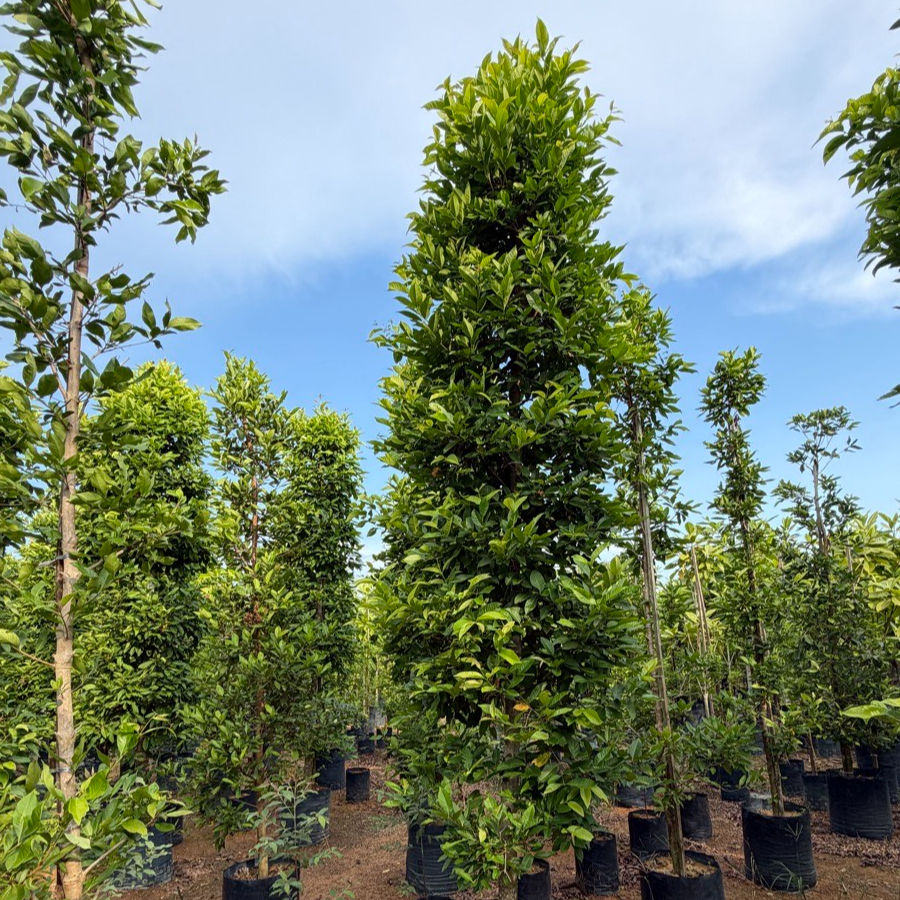
A well-behaved shade tree that also produces the bay leaf used across Malaysian and Indonesian cooking. That dual value suits edible-landscape schemes, school grounds and heritage planting. It establishes steadily, holds dense evergreen foliage and asks very little once settled.
Typical supply: 3.5 m · 40–50 mm girth · 26×28 bag
Tips for Planting Fast-Growing Trees in Malaysia
Choose species suited to your soil type and space
Plant during the rainy season for better establishment
Provide regular watering during dry spells
Mulch around the base to retain moisture and suppress weeds
Prune young trees to encourage strong structure
Selecting the right fast-growing tree can transform your outdoor space quickly while supporting the local environment. These 10 species have proven success in Malaysia’s tropical climate, offering shade, beauty, and ecological benefits.
Start planning your tree planting today and enjoy a greener, cooler, and more vibrant landscape in just a few years.


Comments